

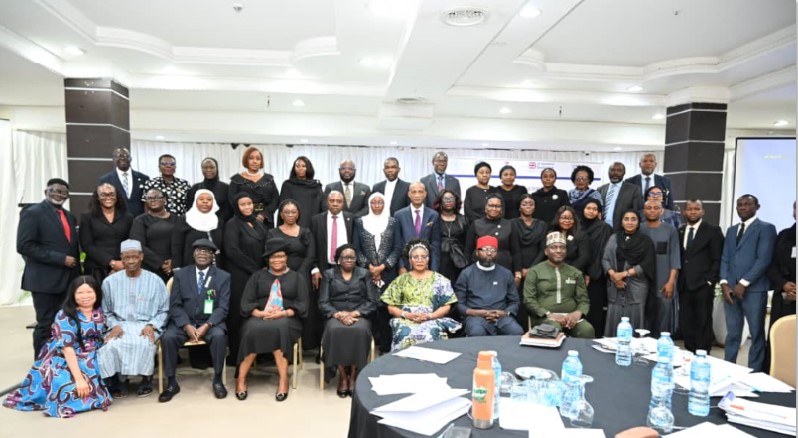
The Chief Justice of Nigeria & Chairman, Board of Governors, National Judicial Institute, Hon. Justice Kudirat Kekere-Ekun, GCON has said a responsive judicial approach to issues of gender, peace, and security is an essential part of justice delivery in a society facing complex security and humanitarian challenges.
CJN Justice Kekere-Ekun made the statement while delivering opening address at a Dialogue Workshop for Judicial Officers on the Women, Peace, and Security Agenda in collaboration with the Federal Ministry of Women Affairs and Social Development; and the Strengthening Peace and Resilience in Nigeria (SPRiNG) aims to garner judicial support for the actualization of the objectives of the UN Security Council Resolution (UNSCR) 1325 on Women, Peace and Security.
Declaring the workshop open, the CJN implores all participants to engage openly and constructively in the sessions ahead, and maintains that the Judiciary’s ability to discharge its constitutional responsibility in times of conflict and vulnerability, and to give practical effect to the objectives of the National Action Plan, depends on our collective commitment to learning, adaptation, and institutional improvement.
.jpeg)
Similarly, the NJI Administrator, Justice Babatunde Adejumo, in his welcome address stressed that the workshop reflects the Institute’s unwavering commitment in facilitating capacity building initiatives that are diverse, inclusive, and which are in tune with international standards and global best practices.
The workshop will deepen judges' understanding of the UNSCR 1325; reinforce the significance of judicial oversight in the execution of the 3rd National Action Plan on Women, Peace and Security (WPS); and refine the National Judicial Guide on Women, Peace and Security.
Justice Adejumo maintained that the Judiciary, as the custodian of justice, stands as a pivotal institution for the advancement of the pillars of the Women, Peace and Security Agenda, particularly prevention, protection, relief and recovery.
In his remarks, Hon. Minister of the Federal Ministry of Women Affairs and Social Development, Hajia Imman Suleiman, OFR, ably represented by Dr Ahmed addressed the need on strengthening women’s participation in society and reinforcing the role of the courts as custodians of rights and arbiters of justice.
Hajia Suleiman placed emphasis on the need for clear judicial guidance on Women, Peace, and Security frameworks in order to address gender-based issues within the justice sector.
The workshop also featured a goodwill message from Amina Akano-Bello of the Gender Equality, Disability, and Social Inclusion unit of the SPRiNG Programme, funded by the United Kingdom Foreign and Commonwealth. She highlighted the Judiciary as a key institution for translating principles of protection and accountability into practical outcomes. She recalled that the first global action plan on Women, Peace, and Security emerged in October 2000 and outlined ongoing efforts aimed at building a stable Nigeria, improving public confidence, addressing drivers of violence, institutionalizing gender responsiveness, and investing in research. She described the workshop as timely and critical for advancing justice, protection, and peace for women and girls, reaffirming commitment to sustained collaboration with judicial officers.

Mrs. Esther Eghobamien Mshelia of the United Nations Convention on the Elimination of All Forms of Discrimination Against Women delivered a context-setting presentation on understanding the Third National Action Plan and its nexus with the Judiciary. She noted that no state within the federation is free from gender-based violence, underscoring the urgency of effective judicial engagement. She outlined the five judicial pillars of the Women, Peace, and Security Agenda, namely prevention, participation, protection, relief and recovery, as well as coordination and accountability.
The opening ceremony was concluded with ceremonial photographs which commemorated the event. These photographs symbolized institutional unity and collective commitment to advancing the Women, Peace, and Security Agenda within the justice sector. They reinforced the shared responsibility of judicial leaders and partner institutions to translate policy commitments into practical justice delivery. The commemoration captured not only the presence of distinguished stakeholders but also a renewed resolve to strengthen protection, accountability, and access to justice for women and vulnerable groups across Nigeria.

A modern HTML template for education, offering intuitive design & essential features for seamless learning experiences.
