


-Justice Alaba Ajileye led discussion on Confession and Circumstantial Evidence
-Prof. Taiwo Osipitan, SAN led discussion on Hearsay Evidence Dilemmas
-Justice O. A. Obaseki-Osaghae led discussion on “Digital, Electronic, and AI-Generated Evidence
The Administrator of the National Judicial Institute, Hon. Justice Babatunde Adejumo, OFR, has reiterated the institute's commitment to providing 21st-century judicial education to ensure fair trial outcomes in the administration of justice.
Justice Adejumo made the statement on Day Two of the Refresher Course for Judges of the Superior Courts in Abuja, held at the National Judicial Institute, Jabi, Abuja.
The Administrator welcomed participants and emphasised that the importance of continuous judicial training in the administration of justice cannot be overstressed, and urged the participants, who are mainly Hon. Judges, to take advantage of the training to learn and re-learn the judicial knowledge needed for better judicial performance.
The programme opened with a session on “Reliance on Confession and Circumstantial Evidence: Safeguards Against Wrongful Convictions,” CEO of Forensic Electronic and Digital Law Consultancy (FEDLAC) facilitated by Hon. Justice (Prof.) Alaba Omolaye-Ajileye (Rtd). My lord explained that judges must decide correctly, ensuring evidence meets constitutional and statutory proof standards.
The session highlighted safeguards under Sections 15 and 17 of the ACJA, 2015, covering procedural protections for arrest documentation and suspect statements. Participants were guided on evaluating circumstantial evidence, confirming that the chain of circumstances is complete, and ensuring the inference of guilt is irresistible. Justice Alaba concluded that careful evaluation, structured reasoning, and strict adherence to proof beyond a reasonable doubt remain the strongest defense against wrongful convictions.
Away from the traditional ways of judicial training, the participants participated in a case study simulation and role-play, wherein they were divided into groups and presented with practical trial scenarios. The exercise encouraged discussion, reinforced collaborative reasoning, and highlighted practical strategies for managing evidence effectively in trials.
The next session, which delved into “Hearsay Evidence Dilemmas: Balancing Fairness and the Risk of Wrongful Admission in Complex Cases,” was led by Prof. Taiwo Osipitan, SAN. The learned Silk discussed the challenges of hearsay evidence, stressing that while it may sometimes be necessary, judges must carefully scrutinize its reliability and admissibility. Participants were guided on statutory exceptions and strategies to prevent wrongful admission while ensuring fairness in complex cases.
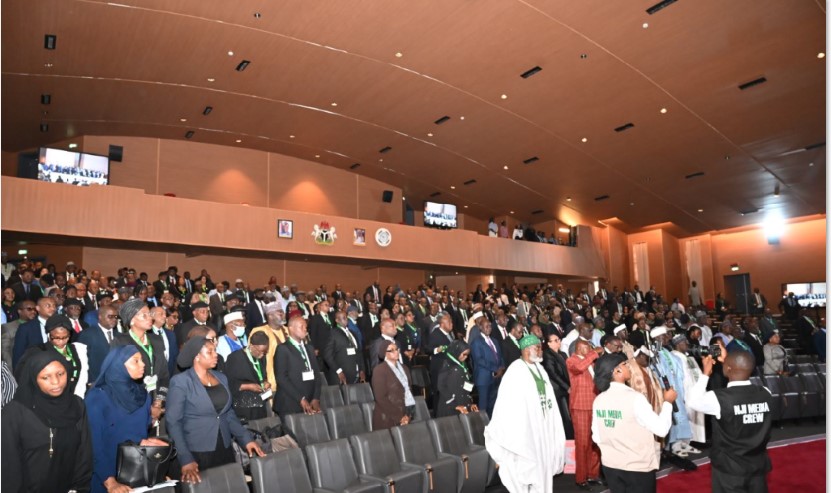
Another key session was handled by one of the judges of the National Industrial Court, Abuja, Hon. Justice O. A. Obaseki-Osaghae, on “Digital, Electronic, and AI-Generated Evidence: Ensuring Authenticity, Preventing Manipulation, and Mitigating Misinterpretation in Cyber-Related Cases.” Milord addressed AI-generated evidence such as facial recognition outputs, AI-enhanced CCTV footage, deepfakes, ChatGPT-generated documents, and predictive analytics. Emphasis was placed on provenance, or tracing the origin and handling of digital content, and the need for careful procedure, competent explanation, and principled reasoning in court.
Judges were reminded that while they are not expected to become technical experts, they must ask clear questions, insist on plain-language explanations, and apply traditional evidential principles. Technology can aid fact-finding but does not replace careful evaluation of relevance, context, and reliability.
The day concluded with an interactive discussion and question-and-answer session, where judges raised practical challenges, shared experiences, and clarified complex evidentiary issues. The session provided insight into emerging trends, reinforced best practices in trial management, and strengthened participants’ confidence in delivering fair, accurate, and reasoned judgments.

A modern HTML template for education, offering intuitive design & essential features for seamless learning experiences.
